
Development of an Air-Quality Index Forecasting System for M
| 論文類型 | 基礎(chǔ)研究 | 發(fā)表日期 | 2005-10-01 |
| 來源 | Macau Environment and City Development 2002 | ||
| 作者 | K.,M.,Mok | ||
| 關(guān)鍵詞 | Macau Air Quality Index Artificial Intelligence EUREKA INTELAIR | ||
| 摘要 | The rapid population and economic growth in the Pearl River Delta and the local traffic volume increase during the recent years has imposed stresses on the atmospheric environment as well as the well being of Macao residents. The increase of public awaren | ||
Macau Environment and City Development 2002
Development of an Air-Quality Index Forecasting System for Macau - A Memoir
K. M. Mok
Department of Civil and Environmental Engineering
Faculty of Science and Technology, University of Macau
PO Box 3001, Macau SAR, China
Abstract: The rapid population and economic growth in the Pearl River Delta and the local traffic volume increase during the recent years has imposed stresses on the atmospheric environment as well as the well being of Macao residents. The increase of public awareness on the ambient air quality propels the development of Macau air quality research studies. The initial study was focused on the concentrations of sulfur dioxide alone with the goal of developing an accurate meteorological dispersion model. Due to insufficient background information and the small geographic size of Macau, this approach was found to be uneconomical or feasible at the time. Application of artificial intelligent techniques in short-term air quality forecasting is then considered and found that it may satisfy the immediate needs of Macau. Researches in this direction were carried out since 1997 and successful application results in Macau are found. The success of the neural network applications on air quality forecasting attracted cooperation intentions from academic and industrial units, and an international EUREKA project was materialized and approved in 1998. The project is with acronym INTELAIR and number EU 1920. The present paper summarized some of the main results obtained in these areas and a memoir on the development of an intelligent air-quality index forecasting system for Macau, which is adopted by the Macau Meteorological and Geophysical Bureau (SMG) for their forecasting applications in Macau‘s daily AQI public broadcast, is presented.
Keywords: Macau; Air Quality Index; Artificial Intelligence; EUREKA INTELAIR
1. Introduction
Macau comprises a Macau peninsula and two islands of Taipa and Coloane with a total area of 25.8 km2 today. It lies on the west side of the Pearl River Delta located at the southeast of China. Hong Kong and Guangzhou situate at 60 km to its East-NorthEast and 105 km to its North, respectively (figure 1). With such geographical location, Macau experienced rapid economic growth as its neighbors in the Delta area in the last decay. The estimated year-end population in 1997 was 422,000[1] which is a 16 % growth from the 363,784 population size in 1991[2]. The corresponding increase of annual gross domestic product (GDP) within that period is from 32,118 million MOP[2] in 1991 to 58,472.1 million MOP[1] in 1997, which translates to a 82 % growth. The consequence of growth is the increase in energy consumption hence, the decrease of environmental quality, especially the ambient air quality. Recognizing the potential impacts of the regional growth on the ambient air environment, the aspiration to comprehend the air-concentration condition as well as its scientific modeling in Macau was stimulated. The year was 1997 and the rest is history.
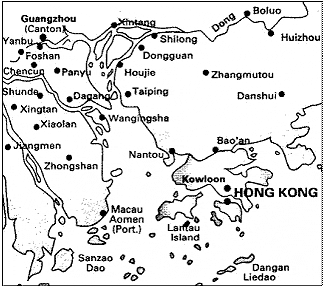
Figure 1. Location of Macau
2. The Initial Stage
At the beginning of the air-quality study started in 1997, focus was put on the development of the more traditional mathematical meteorological and dispersion models, which can describe the relationship between pollutant emission, transmission and ambient air concentrations of the air pollutant as a function of space and time. Feasibility study of this approach was carried out first. It was identified that the calculation quality of the said models depends on precise information on the pollutant emission, wind field, topographic details and even the individual turbulence condition of the atmosphere, just to name a few. Immediately, it was found that there was no systematic study on pollutant emission inventory in Macau. Therefore, the essential local emission data required by the models is not well defined. In addition, the air quality of Macau could also be influenced by the conditions of its neighboring region, e.g. southern China, through long-range transport,[3] which puts in additional difficulty in obtaining accurate estimation of pollutant emission. Even the pollutant emission could be estimated with sufficient accuracy, if the models developed intend to include both of the local and foreign effects from the closer emission sources in the southern China, the spatial scales of such simulation models could range from a few kilometers to tens of kilometers. Then the small size of Macau would appear in the simulated area more of less as a point. With such concern as well as the ill-defined emission inventory of Macau, development of the traditional dispersion model was decided as non-economical (if only the situation in Macau is concerned) or feasible at the time.
3. Re-defining the Goals from the Actual Needs of Macau
Knowing that the development of a traditional air-quality model for Macau may not be suitable at the time, a step backward was taken to review the overall condition in Macau so that research and development goals could be redefined and actual immediate needs of Macau could be satisfied. The first step was to identify what reliable information was available and what were the immediate needs of Macau.
It was found that the most reliable information available for Macau is the monitored ambient air quality, which has been officially recorded by the Macau Meteorological and Geophysical Bureau (SMG) since 1987. During the period of 1987 to 1991, a total of ten measuring stations at eleven locations (figure 2) in Macau were set up to monitor the concentration of seven pollutants including sulfur dioxide, black smoke, nitrogen dioxide, lead, sedimentary particulate, total suspended particulate with diameter less than 100 mm, and PM-10. The SMG had been releasing air quality reports annually since then and the smallest time scale of the released pollutant concentrations is 24 hours; i.e. daily averaged pollutant concentration could be obtained. At the same time, it was also learned that the SMG was starting to set up three continuous ambient air concentration monitoring stations to accurately and effectively record the air quality and planned to launch an air-quality-index release scheme for public information in 1999. Therefore, it was identified that the development of a computationally economical and intelligent short-term air-quality-forecasting system would meet the immediate needs of Macau and subsequent researches were set in this direction.
4. Neural Networks for Air Quality Forecasting
The main objective in air quality forecasting is to predict the values of future air concentration based on values of a number of input variables such as the past air concentration record, related meteorology factors and/or the pollutant emission rate. This is basically a regression problem with the goal of finding a suitable function, which maps the air concentration to related factors. Artificial neural networks (ANN) were considered in vogue for these kinds of modeling applications due to their computation efficiency. A pilot study in testing the applicability of ANN in air quality forecasting for Macau was launched immediately in 1997.
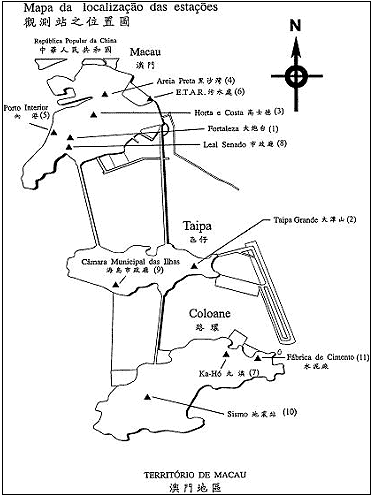
Figure 2. Air-quality monitoring stations in Macau (Source: SMG)
The pilot study was focused on the application of artificial neural networks in short-term prediction of sulfur dioxide concentration in Macau. The reason for selecting sulfur dioxide was due to the more complete data collection that could be obtained from the SMG at that time. In addition sulfur dioxide is one of the primary pollutants, which is of great concern to Macau, as well as to many urban cities in the world, due to its contribution to the local acid rain problems. The forecasting model was based on the assumption that the effects of the underlying deterministic forces like the changing meteorological factors is implicitly embedded in the changing air-concentration time series and the future value of air concentration is only a function of its past records; i.e.
 (1)
(1)
where Ct is the air concentration value at time t, tk with k = 1, 2,…,d, is a non-negative increasing finite sequence and d is called the embedding dimension and F is an unknown function relating the air concentration value at t with its past record. Note that F is a nonlinear function, which could be estimated by ANN through training. The ANN used in the study was a three-layered feed-forward network of the back-propagation type and a definition sketch of it with n inputs, r neurons, and one output is shown in figure 3.
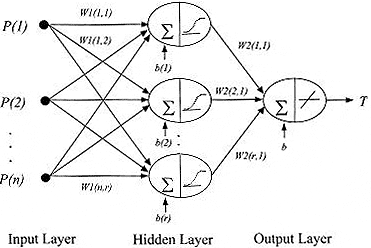
Figure 3. Definition sketch of a three-layered feed-forward network
In the input layer, pattern P(1),P(2), … P(n) is taken. Then they are linearly transformed by the neurons of the input layer. The output signal generated is weighted with W1 (n, r) and fed to each of the r neurons of the hidden layer. Then each of the neurons of the hidden layer sums all the weighted input signals and bias b(r) and produces an overall unit activation which is then converted to an output signal by utilizing a sigmoid transfer function. They are then weighted with W2(r, 1) and fed to the neurons of the output layer. At last the weighted input signals and the bias b of the output layer are summed to produce a unit activation, which is linearly transformed to yield the calculated target value T. The learning method used is the well known back-propagation algorithm.[4] Briefly, this method lets the network learn from the examples sequentially and the values of the adaptive parameters of the networks, the weights and the bias, will be updated so that the cost function and the sum-squared error can be stochastically minimized.
Study of the daily averaged sulfur dioxide (SO2) concentrations in 1995 indicated that Areia Preta at the northern part of Macau was the area that had the highest potential of being polluted; it was identified as the representing site for investigation and the data recorded in the period of October to December was used. In that study, it was assumed that the future SO2 concentration is only related to the evolution patterns occurred during the past thirty days. Based on this assumption and the size of the selected SO2 data, two separate tests were set to examine the prediction ability of the ANN model. One test was to use the data of October to train the networks to predict the first five-day SO2 concentrations of November (Case I), and the other test used the November data to predict the first five-day values of December (Case II). For these five-day ahead prediction tests, the ANN shown in figure 3 was adopted with n = 3 and a time lag of 4 days; i.e. to predict the SO2 concentration at day t, the daily averaged values at days t - 4, t - 8, and t - 12 were used. This arrangement was based on a trial and error basis and it was found suitable for both cases. However, the numbers of neurons used in the hidden layer for both cases were slightly different with Case I using 9 and Case II using 12. The results showed that the accuracy of the ANN model was within 14.5% and 13.7% for the two testing periods, respectively. Figure 4 shows the results of the Case II. These promising results indicated that the ANN could be used to develop efficient air-quality prediction models. The ideas were immediately accepted by the research community and an article "Short-Term Prediction of SO2 Concentration in Macau with Artificial Neural Networks" was published in an international journal in 1998.[5]
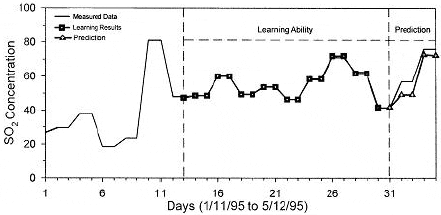
Figure 4. ANN calculated and measured daily average SO2 concentration at A. Preta of Macau during the period of November 1 to December 5 of 1995; the units for SO2 concentration is in mg/m3.
5. International Cooperation - EUREKA
The success of the neural network application on air quality forecasting attracted cooperation intentions from academic and industrial units, and an international EUREKA project was materialized and approved in 1998. The project was with acronym INTELAIR and number E! 1920. The title of the project was "Hybrid System for Urban Air Pollution Management: Artificial Intelligent and Classical Modeling". It officially started in January 1999 with a total budget of 0.5 million Euro. It was a two-year project with seven partners; W. S. Atkins Portugal, Consultores e Proj. Internacion. Lda. and IDAD - Instituto do Ambiente e Desenvolvimento/Environment were from Portugal, United Kingdom Meteorological Office - Consultant Group was from the United Kingdom, Northeast Electric Power Group Corporation of China and Peking University/Institute of Environmental Engineering were from Mainland China, University of Macau/Faculty of Science and Technology and Companhia de Electricidade de Macau, S.A.R.L. were from Macau. The project concluded in January of 2001.[6] The objective of the INTELAIR project was to develop a hybrid air quality forecasting system, which uses both the traditional and artificial intelligent approaches. Our research team at the University of Macau was in charge of developing the INTELAIR Neural Component, the core of the intelligent system that could forecast future air quality based on historical information. The first workshop of the project was held in March of 1999 at University of Macau (figure 5).

Figure 5. Group picture of the partners in the first workshop held at University of Macau in March of 1999.
6. The Air-Quality Index Forecasting System for Macau
As mentioned in Section 3, the SMG installed three continuous monitoring stations (figure 6) in both the Macau peninsula and the Taipa Island so that the needs of air-quality information from the concerned units and more important, the general publics, could be satisfied. In March of 1999 (the same week of the first INTELAIR workshop), the SMG introduced an air quality index (AQI) system and officially started to report the last 24-hour‘s AQI to the general publics; at the same time, the SMG also planned to release one-day ahead AQI forecasts in two years time, i.e. in March of 2001. This immediate local need confirmed our beliefs[7]; i.e. an air-quality forecasting system was in demand. The parallel objectives of our INTELAIR project and the SMG‘s AQI plan propelled the development of an air quality index forecasting system for Macau within our group.
6.1. Validation of ANN Application in AQI Prediction
Before the development of the final forecasting system for Macau, application tests of ANN on the AQI prediction were carried out to re-ensure the approach is feasible even though previous application on short-term SO2 concentration forecasting was successful.[5] The validation was done by using data recorded at the Northern Zone air-quality monitoring station during 1999 for modeling and testing. It is noted that the Northern Zone station is one of the three stations (figure 6) with operation started in 1999. In the following subsections, an introduction to the AQI system used in Macau and the corresponding validation process are presented.
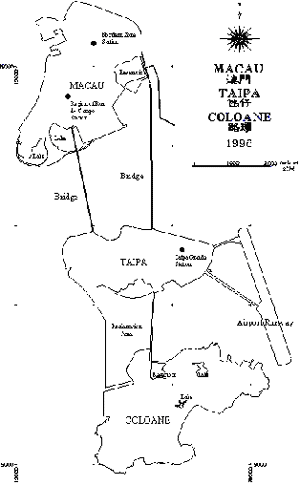
Figure 6. The three continuous air quality monitoring stations in Macau with operation started in 1999; · represents the station.
6.1.1. The Air Quality Index System of Macau
The SMG started in March 1999 to monitor and to report the last 24-hour air quality situation to the general publics in Macau. The air quality is recorded through three continuous monitoring stations located at various sites in Macau as shown in figure 6. The Measured pollutants and the categories of Macau ambient air quality recorded at these stations are as listed in Table 1. It is noted that the operation of the Taipa Grande and the Northern Zone Stations was started in March 1999 while the Region of "Rua do Campo" station was started in July 1999. It is also noted that one more station was added in Taipa Island in 2001 so that a total of four stations are currently operating. In the present paper only the first three stations are introduced.
Table 1. Measured pollutants and site category of the three monitoring stations
In order to provide an easy understanding of air quality to the general public, the SMG uses an Air Quality Index (AQI) system, which classifies the air quality into six levels. Currently there are three daily AQIs announced by the SMG. Each of them represents different categories of the air quality; i.e. the general ambient air quality, the air quality at high (population density) residential area, and the roadside air quality. All of the Macau AQIs are daily indexes that range from 0 to 500 and they come from the linear-segmented transformation of at most five major pollutant concentrations. The major pollutants used are respirable suspended particulate (PM10), sulphur dioxide (SO2), nitrogen dioxide (NO2), carbon monoxide (CO) and ozone (O3). The range of AQI is classified into six bands by the SMG as listed in Table 2. The AQI value within different band corresponds to different level of air pollution. In general the higher the AQI value, the poorer the air quality. In calculating the announced daily AQI, separate sub-index is calculated for each of the five major pollutants. The sub-indexes of the pollutants are converted from their measured concentrations based on the scale listed in Table 3. The reported AQI is defined as the maximum value among this set of sub-indexes. The daily AQIs are reported everyday in the afternoon and the sub-indexes are calculated from corresponding concentrations taken during the period of 12:00 P.M. of the reporting day back to 12:00 P.M. (or 5:00 A.M.) of yesterday for the 24-hr (or 8-hr) average cases.
Table 2. AQI range and its associated air pollution level
Table 3. AQI conversion table used in Macau
PM10
24-hr average
(m g/m3) SO2
24-hr average
(mg/m3) NO2
24-hr average
(mg/m3) CO
8-hr average
(mg/m3) O3
8-hr average
(mg/m3) 0 0 0 0 0 0 50 100 60 80 5000 80 100 150 150 150 10000 160 200 350 800 280 17000 350 300 420 1600 565 34000 600 400 500 2100 750 46000 800 500 600 2620 940 57000 1000
6.1.2. Application Results at the Northern Zone Station
In the validation study, the air pollutant concentrations at the Northern Zone Station recorded during the period of April 1 to July 31, 1999 were used. At this station, all of the five major pollutants used to determine the AQI were measured. Hence the procedures included the development of five independent ANN models for predicting the sub-indexes of the five pollutants. Then the maximum of the five predicted sub-indexes would form the predicted AQI. Since the data available were the daily air quality sub-indexes and the corresponding daily AQI recorded from April to July 1999, for model training, testing and performance evaluation, the data were divided into three segments. The data from April and May were for model training while the data in June were for testing and adjusting the ANN structure. The data in July were used for model performance evaluation by comparison with the model predictions.
As the validation study used the three layer feed-forward network as discussed in Section 4 for forecasting the air quality index one day ahead, the main structure elements needed to be determined were the input pattern (layer) and the number of neurons in the hidden layer. Nevertheless, the exact analysis of the ANN structure is still inconclusive and it is usually determined experimentally. Since the forecast of the final AQI was determined from the maximum of the five predicted sub-indexes, individual model for each pollutant was built as mentioned earlier. It was assumed that the variation of the next day air quality depended only on condition of no more than twelve of the past days (the input pattern). Further assumption was that the ANN structures of all the sub-index models were the same and they were determined by the overall performance on the final AQI prediction test through experiments.
Experimenting on the combinations of different input patterns and their corresponding numbers of neurons in the hidden layer, the most effective ANN structure with the least root mean square error on AQI in the test period was adopted for final prediction. It was found that the structures with the past three-day air quality information as inputs together with eight neurons in the hidden layer gave the best test results. The trained system was then used to forecast the AQI of July 1999 for model verification. Since the forecast was one day ahead, the input data were updated with the actual measurements for each new forecast as it advanced through the month of July. The forecasting results comparing with the actual measurements are shown in figure 7. It was shown that the Models performed relatively well with a mean absolute percentage error of only 15.8% in the prediction period and 96.8 % of the forecasts give the correct main contribution pollutant. It was noted that the air quality index variation in July was relatively mild except at the last ten days; in that period the concentrations experienced a mild jump. The models were still able to capture the main trend with relatively good predictions. The tests were successful and the results were published in Air Pollution VIII[8] in the summer of 2000.
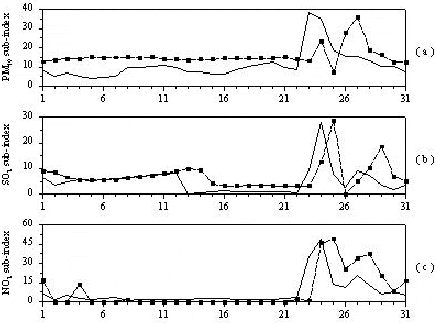
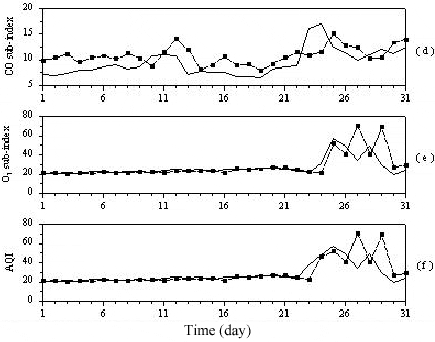
Figure 7. Comparison between the forecasted daily pollutant sub-indexes and final air quality index (AQI) with the measurements at the Northern Zone Station during July of 1999; AQI (graph (f)) represents the maximum value within all pollutant sub-indexes (graphs (a) to (e)) of the corresponding day; —— is measurement and is prediction.
6.2. The INTELAIR Neural Component
With the feasibility study of the ANN application on Macau AQI forecasting completed successfully, development of the intelligent forecasting system for Macau was fully carried out in later part of the year 2000. When the system development was carried out, the objectives of the project were determined first. It was decided that the system would be application software, which is intended to be used by a wide range of professionals with different backgrounds. The development objectives were the software system must be able to run on easily accessible personal computers operated with the most popular operation system; the Microsoft Windows. The developed software should then be a Windows based, user-friendly yet efficient system, and the user should not be required to obtain other commercial software to have it run properly. It was then decided to program the system with the Microsoft Visual Basic 6.0. The complete system includes two stand-lone units: a database management system mainly for air quality information management and analysis (figure 8), and a neural unit for air-quality forecasting baring the name "INTELAIR Neural Component" (figure 9).

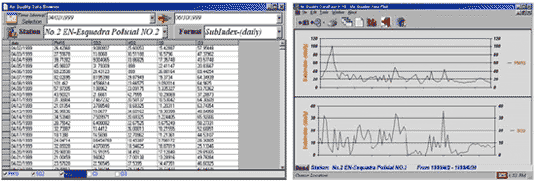
Figure 8. Views of the database management system interface.
Details of the complete system operation are reported by Mok et al.[9,10,11] In short, the database allows the users to store the recorded pollutant concentrations and at the same time offers basic processing features such as data viewing, average calculation, episode identifying, AQI conversion and customized data output. The neural unit is developed for AQI forecasting. It uses a feed-forward neural network based algorithm trained by past AQI record. In other words, forecast of the future AQI is based on the knowledge of its history. The artificial neural network used in the forecasting system is the one described in Section 4 and tested in Section 6.1.

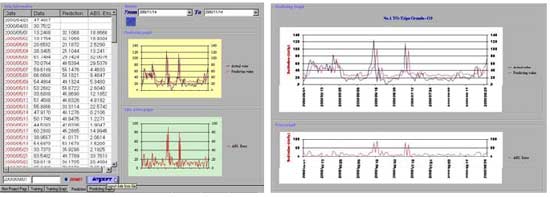
Figure 9. Views of INTELAIR Neural Component interface.
6.2.1. Application in Air Quality Index Prediction
To test the INTELAIR Neural Component on air quality forecasting ability, a time series of daily ozone sub-indices from the Taipa Grande Station in Macao was selected. The length of the data was from May 1, 1999 to August 31, 2000. For model training and performance evaluation, the data were divided into two segments. The data from 05/01/1999 to 04/30/2000 were utilized for model training and testing, while the data from 05/01/2000 to 08/31/2000 were used for model verification as shown in figure 10.
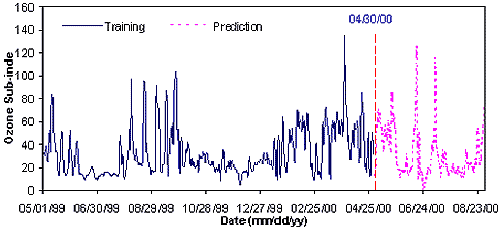
Figure 10. Variation of ozone sub-index from 05/01/99 to 08/31/00.
In order to select the most efficient structure, combinations of different input patterns and their corresponding numbers of neurons in the hidden layer were tried systematically. The training results of the model with this parameter setting are shown in figure 11. The model seemed to learn quite well by picking up most of the large peaks. The prediction of the model was then compared with the actual measurement as shown in figure 12. The network outputs match quite well with the actual values for relatively higher sub-indices. However, it was found that the predicted values lag behind the actual values. Since it was believed that the structure shown may not be the optimal one, improvement could still be made by performing extensive experimental trials on the network structures.
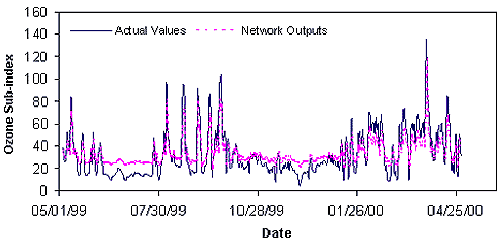
Figure 11. Performance of neural component on ozone sub-index training.
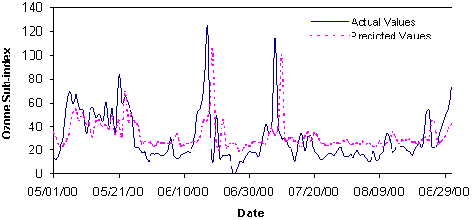
Figure 12. Performance of neural component on ozone sub-index prediction.
7. Adoption of System by Local Authority
The INTELAIR Neural Component was completed by the end of the year 2000 with great success. Since the system is very powerful, efficient and user-friendly, successful applications were found by the SMG during the period of February to May of 2001. The SMG then requested our software for their usage in releasing the daily forecasting AQI. An official transaction of the system from the University of Macau to the SMG was on June 8, 2001 (figure 13). On the same day, the system was also officially introduced to the general publics (figure 14).

Figure 13. Prof. Iu, Rector of University of Macau presenting the INTELAIR NEURAL COMPONENT to Mr. Fung, Director of SMG on June 8, 2001.


Figure 14. Prof. Mok presenting the INTELAIR report and introducing the UM developed neural component to the publics in June 8, 2001.
8. Concluding Remarks
Through studying the air quality situation in Macau, it was identified that the application of traditional air quality modeling techniques may not be suitable at the time. Not giving up on research, it was found through redefining the goals of research by looking into the actual needs of Macau that an air quality forecasting system was in demand. Successful research in application of artificial neural network on air quality prediction led to international recognition and a EUREKA project was resulted. The project finally led to the successful development of a user-friendly and efficient database and intelligent forecasting system for Macau air quality management, which is finally adopted for official usage by the local authority. The entire process involved both researches and development, which lasted for a period of approximately four years and the participation of personnel from different disciplines including civil engineering, mathematics and electrical and electronics engineering. The inter-discipline cooperation experience, and innovative ideas in application of artificial intelligence in air quality study made the road of the entire project both fun and challenging. It is well worth for sharing with the readers and hopefully these experiences would be helpful to those who may be going through similar endeavor in their research and development paths.
9. Acknowledgements
The development of the air quality forecasting system for Macau involved the cooperation and assistance of many personnel and units. Prof. S. C. Tam is the co-principle investigator of the research and development projects discussed in the present paper. Other personnel involved in the scientific and technical assistance are HOI Ka In, YAN Ping, LAM Leong Hong, LEI Soi In, IEONG Ka Kit, WONG Hou and CHAN Choi Iong. The studies were supported by the Research Committee of University of Macau under grant numbers RG002/97-98W/MKM/FST, RG002/97-98S/MKM/FST, and RG025/99-00S/MKM/EUREKA-INTELAIR. The Macau Meteorological and Geophysical Bureau is thanked for supplying the air quality data and the kind support by them in supplying detailed information on the Macau AQI system is highly appreciated.
References
[1] DSEC, http://www.dsec.gov.mo/ (Feburary, 1998).
[2] DSEC, Anuário Estatístico, Servi?os de Estatística e Censos de Macau, (1991).
[3] Arndt, R., Xu, Y., Carmichael, G.R., Sunwoo, Y. & Zhang, Y. (1994) Long Range Transport of Sox in Asia, Air Pollution II, Vol. 1, Computational Mechanics Publications, Southampton and Boston, 245-250.
[4] Rumelhart, D. E., Hinton, G. E. and Williams, R. J. (1986) Learning internal representations by error propagation, Parallel distributed processing: explorations in the microstructure of cognition, (Eds: D. E. Rumelhart, and J. L. McClelland) Vol. 1, MIT Press. Cambridge, Mass., 318-362.
[5] Mok, K. M. and Tam, S. C. (1998) Short-Term Prediction of SO2 Concentration in Macau with Artificial Neural Networks, Energy and Buildings, Vol. 28, 279-286.
[6] http://www.eureka.be/ifs/files/ifs/jsp-bin/eureka/ifs/jsps/projectForm.jsp?enumber=1920
[7] Mok, K. M., Tam, S. C. and Wang, Z. S. (1999) Air-Quality Forecasting System in Macau, Proceedings of the 1st Macau Symposium on Environment and City Development, Macau, 78-85.
[8] Mok, K. M., Tam, S. C., Yan, P. and Lam, L. H. (2000) A Neural Network Forecasting System for Daily Air Quality Index in Macau, Air Pollution VIII, Ed. by Longhurst, J.W.S., Brebbia, C.A., & Power, H., WIT Press, Southampton, 41-50.
[9] Mok, K. M., Tam, S. C., Yan, P. and Lam, L. H. (2000) Forecasting Air Quality Index of Macau I, Research Report CE-2000-01, Faculty of Science and Technology, University of Macau, Macao, pp. 31.
[10] Mok, K. M., Tam, S. C., Hoi, K. I. and Lei, S. I. (2000) Forecasting Air Quality Index of Macau II, Research Report CE-2000-03, Faculty of Science and Technology, University of Macau, Macao, pp. 39.
[11] Mok, K. M., Tam, S. C., Hoi, K. I. and Lei, S. I. (2001) An Intelligent Air-Quality Forecasting System in Macao, The 2001 International Conference and Exhibition on Sustainable Development and Green Enterprises, Nov. 1 - 3, 2001, Macao, 29-O4 - 29-O13.
close
www.niemi.com.cn相關(guān)推薦
- Artificial neural network modeling of water quality of the Yangtze River system: a case study in reaches crossing the city of Chongqing
- An internal airlift loop bioreactor with Burkholderia pickttii immobilized onto ceramic honeycomb support for degradation of quinoline
- Performance of simultaneous nitrification and denitrification in lateral flow biological aerated filter
- Water quality changing trends of the Mi yun Reservoir
- Water quality changing trends of the Miyun Reservoir
- Determination of diallyldimethylammonium chloride in drinkin
論文搜索
月熱點(diǎn)論文
論文投稿
很多時(shí)候您的文章總是無緣變成鉛字。研究做到關(guān)鍵時(shí),試驗(yàn)有了起色時(shí),是不是想和同行探討一下,工作中有了心得,您是不是很想與人分享,那么不要只是默默工作了,寫下來吧!投稿時(shí),請(qǐng)以附件形式發(fā)至 paper@h2o-china.com ,請(qǐng)注明論文投稿。一旦采用,我們會(huì)為您增加100枚金幣。