
Fate and Pathways of Organic and Inorganic Toxicant Pollutio
| 論文類型 | 基礎研究 | 發表日期 | 2005-10-01 |
| 來源 | Macau Environment and City Development 2002 | ||
| 作者 | Zhishi,Wang | ||
| 關鍵詞 | water-sediment phase partitioning adsorption and absorption neutral no polar organic compounds | ||
| 摘要 | Toxicant pollution usually involves persistent organic pollution (PAHs, PCBs, organochlorine pesticides) and heavy metals (Pb, Cd, Cr, etc) in water and sediment as well as biota phases. A long term field monitoring research has been made since 1994 regar | ||
Macau Environment and City Development 2002
Fate and Pathways of Organic and Inorganic Toxicant Pollution in Macau Coastal Waters[1]
Zhishi Wang
Faculty of Science and Technology, University of Macau, Macau
ABSTRACT: Toxicant pollution usually involves persistent organic pollution (PAHs, PCBs, organochlorine pesticides) and heavy metals (Pb, Cd, Cr, etc) in water and sediment as well as biota phases. A long term field monitoring research has been made since 1994 regarding to the toxicant pollution in Macau coastal waters, aiming at finding out the pollution sources of the specific pollutants such as PAHs and tracing back to the pollution histories such as DDTs residue variation along the sediment column samples (1 m depth) as well as identifying high risky pollution zones of the coastal waters (such as Porto Interior or inner port). However, it has been found that solely based on the field monitoring data, the above-listed tasks can only been partially completed, particularly for identification of fate and pathways of the toxicant pollution in the coastal waters. Therefore, it is vitally needed to establish the conceptual models to insight the complex pollution processes occurring in the coastal waters, especially these processes such as volatile organic species exchange between atmosphere and water phases, adsorption and absorption of inorganic and organic compounds on suspended particulate matter, particle settling and pollutants vertical transport, and mass transfer at water/sediment interfaces, as well as tide flow patterns and long distance pollution transport in the coastal waters.
Macau coastal waters are characterized by high turbidity with high suspended solid contents in water column and active mass transfer at water/sediment interfaces. For fate and pathways of organic and inorganic toxic pollution in the coastal waters, it is believed that the pollutant adsorption and absorption on suspended solid surfaces and exchange between water/sediment phases are important while the atmosphere/water exchange is not, because of nonvolatile nature of the persistent organic pollutants. The study of conceptual modeling for the pollution fate and pathways was focused on the water-particulates interaction and exchange processes, particularly for water-solid phase partitioning of persistent organic pollution (e.g., PAHs) in water column and in surface sediments as well as for adsorption and remobilization of heavy metals in the coastal water sediments.
KEYWORDS: water-sediment phase partitioning, adsorption and absorption, neutral no polar organic compounds, heavy metals
Usually an estuary converges a large quantity of runoff from a wide basin such as the Pearl River delta, leading to transport of continent pollutants including anthropogenic inorganic and organic toxicants to the estuary. Urban runoff outfalls from a metropolitan coastal city like Macau also exert adverse impacts on the estuary such as nutrient overloads and persistent toxicant accumulation. The acid rain widely occur in the Pearl River delta including Macao and its neighboring areas, which contributes to nutrient and toxicant pollution of the estuary, too. It is of a common recognition in the scientific society that suspended particles are scavengers for various dissolved toxicants (heavy metals and petro-hydrocarbons) in the coastal waters, particularly the fine particles with diameters less than micrometers being the major media for adsorption of heavy metals and absorption of organic toxicants due to their large specific surface areas. In the estuary region, there usually exist high saline gradients and high energy dissipation which lead to coagulation and sedimentation of fluvial fine particles there so that the heavy metals and organic toxicants attached to the fine particles go to the sediment together with the coagulated particles. So the sediment in an estuary is usually a sink for these toxicants where the toxicant compounds are accumulated and immobilized.
With rapid economic development, the coastal waters of South China Sea faces increasingly environmental stresses, one of which is organic and inorganic toxicant pollution in water and sediment phases, specifically involving persistent organic pollution and heavy metals. The persistent organic pollution can be subdivided into polycyclic aromatic hydrocarbons PAHs, polychlorinated biphenyls PCBs, and organochlorine pesticides such as DDTs and HCHs. The field monitoring and assessment of these toxicant pollutants have been widely made since 90s, particularly in Macau coastal waters [1][2], Victoria Bay of Hong Kong [3], Xiamen Bay [3][4], as well as the whole Pearl River estuary [5][6][7]. These studies were focused on field sites sampling of water and sediment and biota samples, and laboratory atomic absorption and chromatographic analysis of the samples for quantifying contents of the toxicant species in water and sediments. One of the research objectives of these studies was to trace back to the pollutant origins by collecting and analyzing the field monitoring data, which may includes atmospheric input, long distance fluvial transport, as well as local waste dumping (municipal wastewater, urban runoff).
The Pearl River delta is situated in the lower reaches of the Pearl River network which includes West River, Pearl River and East River as well as lots of tributaries connecting these main rivers as a net. Macau is just located at the west tip of the delta. The Macau coastal waters looks like a giant sink of suspended solids converging most of the solids transport fluxes through the west delta water network and in the same time collecting large quantities of organic and inorganic toxicants attached to the suspended particulates and accumulated in the coastal water sediments annually. It has been already recognized that most of the persistent organic pollutants in water environment are hydrophobic and preferring to staying in particulate phase instead of water phase. High affinity of the heavy metals pollutants to particulate phase has also been widely recognized. Therefore the sediments of the coastal waters become a sink of the organic and inorganic toxic pollutants from the upstream regions as well as the local sources. The Macau coastal waters are characterized by high turbidity with high suspended solids levels and active pollution interactions at water/sediment boundary. Therefore, the physicochemical interactions and exchange processes between water and particulate phases are the key for understanding fate and pathways of the toxic pollution of the coastal waters, which involve heavy metals accumulation and possible remobilization of the sediments [8][9][10] and persistent organic pollutants transport and transformation in the sediments [11][12].
1. Field Monitoring Assessment of Toxic Pollution in Sediments [1][2][13]
In March 1997, the first field monitoring program was made over the Pearl River estuary and its upstream waterways. Totally 17 sampling sites were selected to collect surface sediment samples with depths of 10-20 cm, including Guangzhou harbor and Macau coasts. The persistent organic compounds PAHs, PCBs and organochlorine pesticide residues in the samples were measured in laboratory by GC-MSD and GC-ECD chromatographic analytic procedures. It was found that one of the highest persistent organic concentrations occurred in the surface sediments sampled at Porto Interio of Macau (ZB13) which is a sink of suspended fine particles transporting from the upstream waterways. Because of affinity of the hydrophobic organic compounds PAHs and PCBs to solid phase, the fine particles deposition led to accumulation of the toxic compounds in the sediments of Macau. The atmospheric dry deposition might be of another source of the organic pollutants accumulation in the sediments. Table 1 presents the details of the field monitoring results.
Table 1 Concentrations of organic contaminants in sediment samples [1]
Lingdingyang Bay
Macau Porto Interio Wanqingsha Shenzhen bay Lingding island Qiao Jiuzhou Bay Macau Nam Van LakeOrganochlorinated pesticides
HCHs 1.6 0.14 1.45 2.64 1.65 2.36 2.85 DDTs 10.17 2.6 12.31 10 10.63 115.61 1628.81 Other pesticides 5.98 2.89 3.87 9.68 8.09 11.46 26.52 Total pesticides 17.75 5.63 17.63 22.32 20.37 129.43 1658.18Polycyclic Aromated Hydrocarbons PAHs Naphthalene (Na) 55.77 10.77 32.81 40.22 43.72 43.29 50.15 acenaphthene 10.84 nd nd nd 43.72 43.29 3.58 acenaphthylene nd nd nd nd nd nd 7.16 Fluorine (Fl) 54.22 nd 15.44 65.36 87.43 86.58 32.24 Phenanthrene (Ph) 109.3 11.24 60.15 65.36 65.57 64.94 136.69 Anthracene (An) 10.41 nd 5.47 5.45 5.46 5.41 20.63 Fluoranthracene (Flu) 33.83 5.5 20.41 21.28 25.66 25.41 247.58 Pyrene (Py) 26.02 5.5 23.33 18.24 14.26 14.12 221.79 Benzo(a)anthracene 23.42 5.5 14.58 9.12 8.55 8.47 162.48 Chrysene (Chr) 62.46 11 35 39.52 37.06 36.7 232.11 Benzo(b)fluoranthracen 54.65 22.48 28.87 130.72 206.09 204.08 1786.87 Benzo(k)fluoranthracen 31.23 22.48 18.37 65.36 131.15 129.87 1326.33 Benzo(a)pyrene (BaP) 31.23 11.24 18.37 43.57 74.94 74.21 1492.12 Indene(1,2,3-cd)pyrene 33.83 22.48 21 87.15 112.41 111.32 1326.33 Dibenzo(a,h)anthracene 26.02 5.62 10.5 43.57 56.21 55.66 957.91 Benzo(ghi)pyrene 36.43 22.48 26.25 98.04 93.68 92.76 1215.81 16 TCL PAHs 599.68 156.32 330.55 732.96 1005.91 996.11 9219.78 2-3 ring PAHs (%) 40.11 14.08 34.45 24.07 24.45 24.45 2.72 Total PAHs* 2284.1 323.07 995.76 1959.96 2372.16 2349.06 14811.5
*: Total PAHs include parent PAHs, Alkyl-PAHs, N/S - PAHs (μg/kg, dry weight)
Therefore, the Macau coastal waters has become the highly ecologically risky water zone of the persistent organic pollution because of high accumulation of these compounds in the sediments of the coastal waters. In order to further clarify the highly risky persistent organic pollution in the coastal waters, particularly to find out specific sources and pathways of specific persistent organic compounds, the follow-up field monitoring program was made in October 1998 with 45 sampling sites located around the coastal waters (e.g., at Porto Interio, Porto Externio, Nam Van Lake, Coloane water area, etc.) and the surrounding waterways such as Qianshan river, Shizimen waterway, Maliuzhou waterway, Jiuzhou port. The persistent organic compounds in the surface sediment samples were analyzed and measured by the same procedures in laboratory as it did in March 1997. It was found that the distribution profiles of unsubstituted PAHs or parent PAHs (P-PAHs) among these sampling sites were following the similar patterns. The P-PAHs analyzed included benzo[e]pyrene(BeP), benzo[a]pyrene(BaP), benzo[b]fluornthene(BbFlu), inde[1,2,3-cd] pyrene (In[1,2,3-cd]P). The monitoring data clearly indicated that these PAHs pollutants came from the identical source through the similar pathways to the coastal waters, i.e., fluvial transport of suspended solids with highly accumulated PAHs. It is some sort of non-point pollution source initiated over large areas of the upstream delta.
The PAHs contents in the surface sediment samples at Porto Interio sites (MC25-34) were found to be in the range of 4000-7000 ng/g dry weight dramatically higher than these of the other sites (1000-2000 ng/g dw), which indicates that there exists another local pollution source leading to the extremely high PAHs pollution level in the Porto Interio samples. It is believed the source was of Macau urban runoff and municipal wastewater discharge into the water zone surrounding Porto Interio. Table 2 presents the details of the field monitoring output.
Among these samples taken at sampling sites except Porto Interio, the values reflecting the dependencies of the ratio of Alkyl-PAHs/P-PAHs vs. the ratio of low molecular weight (LMW)/high molecular weight (HMW) were found to be close each other (1.3-2 vs. 0.6-1.2) while the dependencies of these two ratios at Porto Interio showed a different picture with quite scattering of the ratio dependency values, which further confirmed existence of the local pollution source near Porto Interio. Another dependency between the ratios of Bap/BeP and BaA/Chr were studies among these sample sites, too. The Bap/BeP and BaA/Chr ratio dependency reflects bio-degradation of the PAHs compounds in water environment, which can also be used to indirectly identify the pollution sources and pathways. The ratios of BaP/BeP for the Porto Interio sediment samples were found to be close to these of the other sites, which means that the high rings PAHs (>5 rings) pollution sources are identical among these sites including Porto Interio. On the other hand, the ratios of BaP/Chr at Porto Interio were much higher than the other sites, which means that for the low ring PAHs (< 4 rings) pollution, Porto Interio is near the local point pollution source and the other sites are far away from the source.
By further analyzing the chemical compositions of the low and high ring PAHs in the samples from the different sites and on comparison with the PAHs compositions of aerosol and dust in ambient air samples of Macau, the third pollution source of the PAHs in the coastal waters was identified by this field monitoring study, i.e., atmospheric dry deposition. Figure 1 a, b, c, d present the 3-4 rings P-PAHs and 5-6 rings P-PAHs compositions, respectively among the samples of Porto Interio and the other sites in the coastal water sediments as well as the aerosol and dust samples of ambient air of Macau. It was found that the low ring (3-4 rings) PAHs compositions were quite different among these samples while the high ring (5-6 rings) PAHs compositions are similar between the air particulate and water sediment samples including these of Porto Interio, which means that part of the high ring PAHs came
Table 2 Field Monitoring Results for PAHs in Sediments (ng/g, dw)[2]
Note: qMCxx - Qianshan River; iMCxx - Porto Interio; sMCxx - Shizimen Waterway; mMCxx - Maliuzhou Waterway; nMCxx - NamVan Waterway; cMCxx - Coloane Waters; jMCxx - Jiuzhou Port; eMCxx - Porto Exterio. Na - naphthalene, Fl - fluorine, Ph - phenanthrene, An - anthracene, Flu - fluoranthrene, Py - pyrene, BaA - benzo(a)anthracene, BaP - benzo(a)pyrene, P-PAHs - parent PAHs, A-PAHs - alkyl-PAHs, O/S-PAHs - oxygen/sulfur PAHs, T-PAHs - total PAHs
From the atmospheric dry deposition and the PAHs transfer at water/air boundary is one of the important pathways of the PAHs pollution in the coastal water sediments, particularly for the high ring PAHs.
By further analyzing the PAHs compositions in the sediment samples, it was found that the PAHs pollution was constituted by three main PAHs groups caused by three different pollution sources, i.e., group I Alkyl-PAHs and O/S PAHs counting for about 30% of the total, which reflects petroleum pollution related to the urban runoff from the Macau city; and group II high molecular weight PAHs (228-302) counting for 27% and resulting from high temperature combustion of fuels. The composition was close to that of the aerosols in ambient air. It may come from vehicular exhaustion emission of the Macau city through the atmospheric dry deposition. The group III was of low molecular weight PAHs counting for 18% of the total which are products of low temperature combustion of oil and may be input by fluvial transport from the upstream delta. The remaining PAHs included 6.5% volatile polycyclic naphthalene and dimethylnaphthlene and 2% PAHs species from geological mineralization in nature.

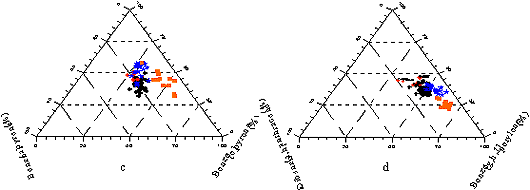
Figure 1 P-PAHs chemical compositions in sediments and aerosols in Macau [13]
The laboratory affiliated to Macau Medication Bureau has made a long term field monitoring program since 1992 for monitoring the annual variation of heavy metals in the surface sediments of the Macau coastal waters. Table 3 gives the 1997 monitoring results [9] of the heavy metals Pb, Cd, Cr and non-metal As in the sediments. It was found that the partitioning coefficients (Kd) were 7,600 - 20,000 l/kg among these species at interfaces between pore water and sediment, which means that the pollution species have been already accumulated in the sediment as the persistent organic pollutants (e.g., PAHs) were.
Table 3. Monitoring results of heavy metals and other toxic species in the water phase (W) and the sediment phase (S) [9]
In March 1997, a sediment column with 70 cm depth was taken at Nam Van Lake for measuring variations of heavy metals contents along the column depth. The heavy metal contents then were measured in laboratory by atomic absorption procedure. The heavy metals involved were Pb, Cu, Zn, Ni, Cr and Cd as well as As. By the 210Pb measurement, the sediment column was aged to estimate annual variation of the heavy metal species in the period of 60s to 90s. It was found that there were peak contents of these heavy metal pollutants occurring in 90s, which is just a period of rapid economic development of the Pearl River delta. It has been recognized that the estuary sediment is not only a sink for heavy metal pollution but also a second source for heavy metals ‘fixed‘ in the sediment releasing back to the water body. The sediment ‘fixed‘ heavy metals may be remobilized from the sediment if the environmental chemical condition at water/sediment interfaces changes due to coincidence of other pollution events. For example, overloading of degradable organic and nutrient wastes from sewage at the interface may lead to anoxic environment there and anaerobic acidification of organic wastes will produce various volatile fatty acids accumulated in the surface sediment [14]. Some physical processes occurring at the interface can also cause metal remobilization. For example, resuspension of the surface sediment resulting from high shear stress near shores may dramatically change the pH and redox conditions, leading to metal release from the sediment. It has been shown that the pH change and periodic redox cycles can shift the metal binding fractions on the sediment particulate surfaces to more mobilizing and soluble [15].
close
www.niemi.com.cn論文搜索
月熱點論文
論文投稿
很多時候您的文章總是無緣變成鉛字。研究做到關鍵時,試驗有了起色時,是不是想和同行探討一下,工作中有了心得,您是不是很想與人分享,那么不要只是默默工作了,寫下來吧!投稿時,請以附件形式發至 paper@h2o-china.com ,請注明論文投稿。一旦采用,我們會為您增加100枚金幣。